How I Found Balance Through Qigong After Injury
After months of slow recovery from a physical setback, I felt stuck—until I tried qigong. This ancient practice didn’t just help me move better; it changed how I heal. Blending gentle motion, breath, and focus, qigong became my daily reset. It’s not a cure, but it’s powerfully supportive. If you’re rehabbing quietly, wondering what else might help, this is for you. More than a routine, it became a way of listening—to my body, my energy, and the quiet signals I’d ignored for too long. In time, the shifts weren’t just physical. They reached into how I slept, how I managed stress, even how I viewed progress. This is the story of how small movements led to meaningful change.
The Moment Everything Slowed Down
It started with a fall—nothing dramatic, but enough to pull everything out of alignment. A minor ligament tear in the knee, the doctor said. Nothing surgery can’t fix, they assured me. So began the months of physical therapy, ice packs, and cautious steps. At first, there was hope. Each week, I expected to feel stronger, freer. But progress plateaued. The exercises felt repetitive, mechanical. My body responded in fits and starts, stiff in the mornings, fatigued by midday. The frustration grew quietly, like a shadow stretching longer each evening. I could walk, yes, but not without awareness of limitation. Stairs were a negotiation. Long standing, a challenge. Even sitting for too long brought a dull ache that whispered, You’re not quite right.
What troubled me most wasn’t just the pain, but the loss of rhythm. I used to move through my days with ease—preparing meals, tending to the garden, walking the dog. Now, everything required calculation. I felt disconnected from my own body, as if it had become an unreliable machine. The emotional toll followed. I grew impatient. Motivation waned. I began to question whether I’d ever feel whole again. Traditional rehab had done its part—stabilized, strengthened, guided—but something was missing. It wasn’t until a friend mentioned qigong, almost in passing, that I considered a different path. Not as a replacement, but as a companion to recovery. Not to fix, but to restore balance.
What Qigong Really Is (And What It’s Not)
Before I began, I had assumptions. I pictured flowing robes, mystical chants, or dramatic energy displays. What I discovered was far more grounded. Qigong—pronounced chee-gung—is a centuries-old practice rooted in traditional Chinese medicine, built on the idea that life energy, or qi, flows through the body. When this flow is disrupted, discomfort or imbalance may follow. Qigong aims to cultivate and harmonize that energy through three foundational elements: regulated breathing, intentional movement, and mindful awareness. Together, they form a system that’s gentle, repeatable, and deeply attuned to the body’s natural rhythms.
It’s not about dramatic poses or athletic feats. There’s no competition, no performance. Instead, qigong emphasizes slow, deliberate motions—like lifting the arms as if through water, shifting weight from foot to foot with full attention, or standing in stillness while breathing deeply into the lower abdomen. These movements are designed to be accessible. You don’t need flexibility, strength, or prior experience. Whether seated, standing, or moving slightly, the practice meets you where you are. It’s not a spiritual ritual, though it can feel meditative. It’s not a cure-all, but it is a tool—one that supports circulation, calms the nervous system, and improves body awareness in ways conventional exercise often overlooks.
Perhaps most importantly, qigong doesn’t demand perfection. It invites presence. The goal isn’t to achieve a perfect form, but to stay connected to each breath, each motion. Over time, this awareness becomes its own kind of strength. It teaches you to notice tension before it becomes pain, to sense fatigue before it becomes exhaustion. In recovery, that kind of insight is invaluable.
Why Movement Matters in Recovery—Even When It Hurts
One of the hardest lessons in rehabilitation is that stillness, while sometimes necessary, can become its own obstacle. When we stop moving, muscles weaken, joints stiffen, and circulation slows. This phenomenon, known as disuse atrophy, affects not just muscle mass but also coordination and balance. The body begins to forget how to move fluidly. For someone recovering from injury, this can create a cycle: pain leads to reduced activity, which leads to more stiffness, which leads to more pain. Breaking that cycle requires movement—but not the kind that strains or shocks the system.
This is where qigong’s gentle approach becomes powerful. Unlike high-intensity workouts that stress recovering tissues, qigong uses micro-movements to stimulate the body without overloading it. Each slow lift of the arm, each shift of weight, encourages blood and lymphatic fluid to flow more freely. This improved circulation helps reduce inflammation, deliver nutrients to healing tissues, and remove metabolic waste. At the same time, the focused breathing activates the parasympathetic nervous system—the part responsible for rest and repair. This dual action supports both physical and neurological recovery.
Think of a rusted hinge. Forcing it open with strength may cause damage. But with gentle, repeated motion, oil gradually penetrates, and movement returns. The body responds similarly. Small, consistent actions reawaken neural pathways, helping the brain reconnect with muscles that have been underused. Over time, coordination improves. Balance steadies. Movements that once felt effortful become smoother, more automatic. Healing, in this sense, isn’t about pushing harder—it’s about engaging more wisely. Qigong offers a way to stay active without aggravating injury, to rebuild confidence in movement without fear.
My First Real Qigong Routine—Simple But Not Easy
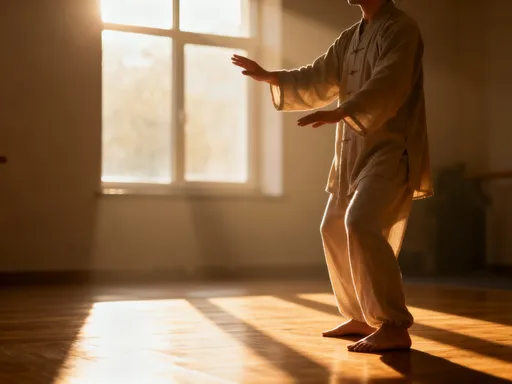
I started small—ten minutes a day, in the quiet of my living room. I followed a basic sequence from a certified instructor’s online video, chosen after verifying their credentials through a recognized qigong association. The routine included simple actions: standing with feet shoulder-width apart, breathing deeply into the belly, and slowly shifting weight from one leg to the other. Then came arm movements—rising gently to chest height, palms facing down, then lowering with control. Each motion was synchronized with the breath: inhale as the arms lifted, exhale as they fell.
The first few sessions were humbling. My legs trembled during weight shifts. My arms felt heavy, uncoordinated. At one point, I felt a slight dizziness—likely from focusing so intently on breath and movement at once. But I didn’t stop. I adjusted—shortened the duration, simplified the motions, took more pauses. What surprised me most was how much mental focus it required. This wasn’t passive stretching. It demanded attention. I had to remind myself not to rush, not to compare, not to judge. The goal wasn’t performance, but presence.
Within two weeks, subtle changes emerged. I noticed I was sleeping more deeply. The morning stiffness in my knee lessened slightly. My shoulders, which I hadn’t realized were perpetually tense, began to drop. I didn’t feel “healed,” but I felt more connected. The practice wasn’t fixing my injury overnight, but it was creating space for healing to happen. I began to look forward to those ten minutes—not as another task, but as a moment of quiet return to myself.
Building a Sustainable Practice—No Guru Needed
Consistency, not intensity, became the key. I didn’t try to double the time or add complex forms. Instead, I increased gradually—five minutes every week until I reached twenty minutes daily. I also began integrating mini-practices into my day: a few deep breaths while waiting for the kettle, a brief standing meditation before checking email, a gentle neck roll while folding laundry. These micro-moments reinforced the rhythm of awareness without demanding extra time.
I found small adjustments made a difference. Practicing barefoot on a yoga mat helped me feel more grounded. Facing a window allowed natural light to anchor the practice in the present moment. When possible, I aligned my morning session with sunrise—a symbolic and physiological cue that helped regulate my energy for the day. I also started a simple journal, noting how I felt before and after each session: energy levels, pain intensity, mood. Over time, patterns emerged. On days I practiced, I had more stamina. On days I skipped, I felt heavier, more reactive to stress.
Perhaps the most important shift was in mindset. I stopped seeing qigong as a tool to “fix” my body and began viewing it as a way to listen to it. Instead of pushing for progress, I learned to honor limits. Some days, the practice was three minutes of stillness. Others, it was a full sequence. Both were valid. This flexibility made the routine sustainable. I wasn’t dependent on a teacher or studio. I had the tools, the knowledge, and the permission to adapt. Qigong became not just a practice, but a habit—a quiet commitment to showing up for myself.
When to Pair Qigong With Professional Care
It’s essential to emphasize: qigong is not a substitute for medical treatment. It does not replace physical therapy, surgery, or prescribed rehabilitation protocols. Instead, it works best as a complementary practice—one that enhances, not replaces, professional care. Before beginning, I consulted my physical therapist and shared my intention to incorporate qigong. They reviewed the movements I planned to use and confirmed they wouldn’t interfere with my recovery. In fact, they noted that the focus on balance and body awareness could support my progress.
Throughout my journey, I remained in communication with my healthcare providers. If a movement caused sharp pain or increased swelling, I stopped and reassessed. I never used qigong to push through discomfort or to avoid necessary treatments. Instead, I used it to support them—to reduce stress that could slow healing, to improve sleep that aids tissue repair, and to maintain mobility without strain. There were times when my therapist suggested modifications, and I adjusted accordingly. This collaboration ensured that qigong remained a safe, integrated part of my recovery.
The message is clear: informed practice matters. Seek guidance from certified instructors. Verify the credibility of online resources. Always prioritize medical advice over anecdotal claims. Qigong can be a valuable layer in your healing journey, but it should never be the only one. When used wisely, it enhances professional care—it doesn’t compete with it.
The Unexpected Gains—Beyond Physical Healing
The physical benefits were real, but the emotional and mental shifts surprised me most. Over time, I noticed I was less reactive to daily stressors. A delayed appointment, a spilled drink—these no longer triggered frustration. I responded with more patience, more pause. This wasn’t because life had changed, but because my inner landscape had. The daily practice of breath and movement had trained my nervous system to return to calm more easily. I was no longer living in a state of low-grade alertness.
My focus improved. I could read for longer stretches, remember details more clearly, and engage in conversations without mental fatigue. I began to feel more present—not just during qigong, but throughout the day. This presence deepened my motivation for recovery. Instead of viewing healing as a distant finish line, I began to appreciate the process. Each small improvement felt meaningful. Each day of practice was an act of self-care, not just self-correction.
I came to see qigong as a way of recharging a battery I hadn’t known was drained. The practice didn’t promise instant transformation, but it delivered steady renewal. It reminded me that healing isn’t just about repairing tissue—it’s about restoring wholeness. And wholeness includes not just the body, but the mind and spirit. The quiet discipline of showing up each day, breath by breath, movement by movement, became a quiet form of resilience.
In the end, qigong didn’t erase my injury. But it changed my relationship to it. I stopped fighting my body and began partnering with it. I learned to move with greater awareness, to breathe with deeper intention, and to live with more balance. Recovery, I realized, isn’t just about returning to how things were. It’s about discovering how they can be—gentler, wiser, more attuned. For anyone walking a slow healing path, wondering what else might help: consider the quiet power of small movements. They may not shout, but over time, they speak volumes.